


What Is Insulin Resistance?
Today I’d love to talk about insulin resistance.
Have you heard of it?
Do you know the long-term health effects?
Do you maybe have some of these symptoms?
- You are constantly hungry, even soon after eating.
- You can’t skip a meal or go long between meals, your hunger is urgent.
- If you have to wait for food, you become irritable and “hangry”, have low mood and low energy or fatigue. You may also feel dizzy, nauseous, weak, headache-y and anxious.
- You dread going anywhere without knowing where you can get food or with a stash of food in your bag. Or you graze throughout the day to avoid feeling hungry.
- You get sugar/carb cravings. You really can’t resist those biscuits, chocolates, crisps or other processed foods.
- You can’t concentrate long enough, you may have brain fog.
- You have trouble sleeping, you regularly wake up in the night, hungry or with a racing heart.
- You are gaining weight in the tummy area (your waist circumference and your waist-to-hip ratio are increasing) and struggle to lose weight.
- Your menopausal symptoms are getting worse.
- You feel thirsty a lot.
- You need the loo a lot.
- You have tingling hands/feet.
- You are ill all the time, catching all the viruses going around.
- You have hormonal problems, e.g. PCOS.
- You have skin issues, such as pigmentation and skin tags.
- Your blood test shows elevated HbA1c.
- Your fasting blood glucose is elevated.
- Your blood pressure is creeping up.
- You are taking statins (cholesterol lowering drugs).
The Science-y Bit.
Glucose is a sugar molecule in your blood that increases after you have eaten a meal.
It affects your blood sugar levels, and with poor blood sugar balance, you get blood sugar spikes and crashes.
Insulin is the pancreatic hormone that regulates your blood sugar levels and the glucose uptake into the cells.
Insulin is like the courier who knocks on your door or rings the doorbell, delivering a parcel (of glucose) to your cells.
With that knocking on the door/door bell ringing, the cell knows to open the gates along its membrane to let in glucose, i.e. accepting the parcel from the courier.
It’s really important to get that glucose into the cells as it’s needed for the production of cellular energy within the cell.
The problem is that when we have a high sugar, high refined carbohydrate diet and when we are frequently snacking, it leads to too much free glucose in the blood.
Too much glucose in the circulation is harmful to the body and can lead to glucose binding to fats and proteins making them damaged and useless.
This is know as glycation.
You might be familiar with a blood marker HbA1c, or glycated haemoglobin, which is an important health marker for diabetes.
The consequences of glycation are AGEs, or advanced glycation endproducts that, as the abbreviation so aptly suggest, is linked with premature ageing.
So eating too much sugar and refined carbohydrates can age you prematurely!
And it doesn’t stop there, if the high glucose levels carry on for longer periods, it will lead to your cells becoming less sensitive to that insulin (courier) signalling (knocking the door/ringing the doorbell), leading to insulin resistance.
It’s like you are at home and some mischievous kids coming to your door, ringing the bell and then running away, so when you open the door, there’s nobody there.
If they keep doing this all day long, you will just decide not to open the door any more.
With glucose and cells, it also means the the cells are initially saturated with glucose from already taking up so much that there’s no need or space for it until it’s used up.
So no need to open the gates.
And if you don’t use the excess glucose up by moving your body and keeping active, and instead, are constantly snacking while sitting at your desk for instance, the cells just don’t hear that knocking/doorbell any more even when they will be starved off glucose and energy.
So your cells need that glucose, but it all stays in the blood.
And there’s also too much insulin in the blood.
This kind of state in the body is highly inflammatory and harmful and contributes to abdominal weight gain and can lead to many chronic conditions, such as diabetes, fatty liver disease, dementia/Alzheimer’s disease, heart disease and hormone-related conditions, as shown in the image above (taken from a recent study, linked under the image).
So how can you know if you may have insulin resistance and what can you do about it?
Go back to the symptom list above and see if you experience these kinds of symptoms regularly. Not all but some of them, as the symptom presentation will depend on how far the condition has progressed and how well your body is managing to control them.
Having some of these symptoms regularly (e.g. constant sugar cravings, waking up at night hungry despite having eaten dinner, or excessive thirst) may indicated you have insulin resistance or are at risk of developing it.
In that case you really need to start addressing the root causes now before things get worse.
Insulin resistance really is a recipe for disaster for your long-term health.
This study discusses the mechanisms, and the many consequences, such as insulin resistance: obesity, diabetes, non-alcoholic fatty liver disease, cardiovascular disease, polycystic ovary syndrome (PCOS) of insulin resistance (see the image below).
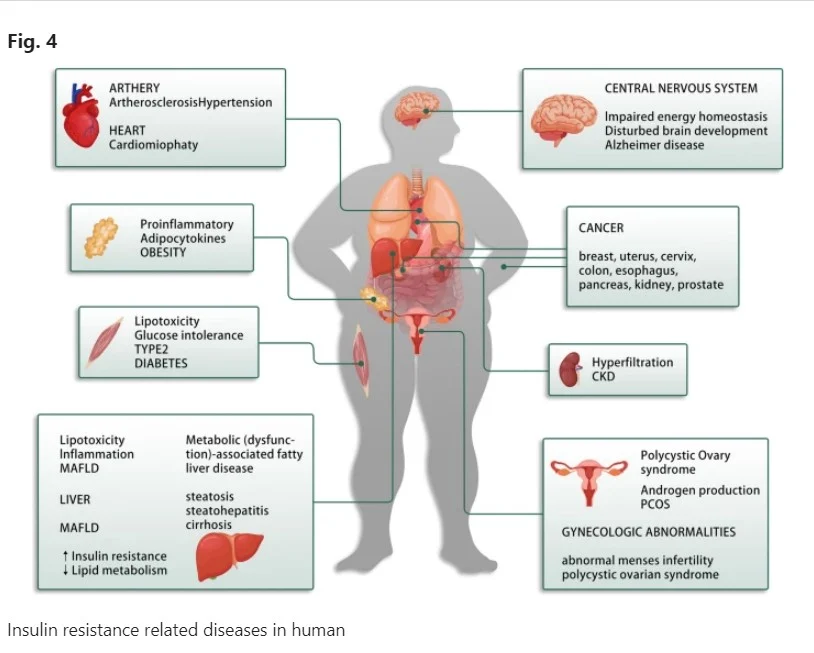
(Source: https://www.nature.com/articles/s41392-022-01073-0)
As you can see, these are serious diseases and not to be ignored.
The best treatment is always prevention with diet and lifestyle modifications, but they can also help you reverse the condition.
Studies also show that a healthy gut microbiome is linked to better insulin and glucose management and lower risk of insulin resistance.
So looking after your gut health is one of the most important things you can start doing when you want to lower your risk of insulin resistance, (pre)diabetes and any other of the associated chronic conditions (see image above).
Remember, insulin resistance and (pre)diabetes mean that your body is intolerant to sugar and carbohydrates.
When you understand this, it makes it easier to know what to do to reverse it.
Here are my top tips for managing blood glucose levels and lowering the risk of (or reversing) insulin resistance:
- Reduce the amount of sugar, refined carbohydrates and processed foods in your diet.
- Eat 2-3 healthy balanced main meals with adequate protein daily, with no snacking in-between.
- Shorten your daily eating window.
- Stop eating at least 2-3 hours before bedtime.
- Reduce inflammation in your body with an anti-inflammatory diet.
- Eat to support a diverse gut microbiome, better digestive function and overall better gut health.
- Avoid a sedentary lifestyle. A 15-minute brisk walk after each meal can support optimal blood sugar regulation.
If you need support with any of the above, I’d love to help you feel better and in control. Check out my Personalised Nutrition Programmes here.
****************
To find out how powerful diet, nutrition, lifestyle and mindset can be for our health, please book your FREE no-obligation discovery call with Minna and let’s have a chat.
You can also contact me via the contact form or [email protected].
Download your FREE copy of Happy Gut – Happy You for simple everyday hacks to feel happier and healthier.
Join my FREE Facebook Group Healthy You – For Life for health and nutrition tips and advice and delicious healthy recipes.