


Are you confused about healthy eating guidelines? Are you struggling to include the ‘5-a-day’ that the government is recommending? Is ‘5-a-day’ even enough? Are you aware of how much of each macronutrient, i.e. carbohydrates, protein and fat, you should be consuming? Is it even necessary to count these macronutrients?
In this series of three blog posts I will be explaining three different healthy eating guidelines by three different organisations. These three healthy eating guidelines, or plate graphics with advice on what we should put on our healthy plates, are:
1) UK Government Eatwell Guide
2) BANT Wellbeing Guidelines
I will introduce each of these in a separate post, as well as give you my opinion of them. This is the second of the three posts, the last article, detailing the ANH Food4Health Guidelines, as well as my 4 simple tips for what to put on your healthy plate, will be available soon. The first article on the government Eatwell Guide can be found here.
2) BANT Wellbeing Guidelines

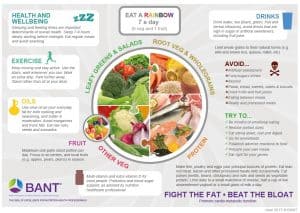
(click HERE and HERE to enlarge the pictures)
BANT, or British Association for Applied Nutrition & Nutritional Therapy, is the professional body I belong to as a registered nutritionist and nutritional therapist. BANT Wellbeing Guidelines are based on the latest evidence and on the notion that every individual is unique and no one diet is right for everyone. BANT guidelines provide a good basis for healthy lifestyle when personalised advice in not possible.
There are two BANT plates:
1) The Wellness Solution (general advice for those with no specific health conditions)
2) Fight the Flab – Beat the Bloat (more specific guide for those wanting to lose weight or suffering from digestive issues)
As you can see, on both plates, vegetables cover most of the plate. Leafy greens and salad vegetables have their own quarter and other non-starchy veg another quarter, together making up half the plate. Root vegetables are grouped together with wholegrains, together taking up a quarter (‘Wellbeing Solution’) or slightly less than a quarter (‘Fight the Flab’). Fruit is not included directly on the plate but as an additional circle, with the advice being 1-3 portions a day in the ‘Wellbeing Solution’ and max. 1 portion in the ‘Fight the Flab’. There is also a limited amount of dairy in the ‘Wellbeing Solution’, but not in the ‘Fight the Flab’.
What’s good about the BANT Wellbeing Guidelines:
Two plates for different purposes/goals
We are all unique and different, and there is no one perfect diet for everyone but personalised/individualised advice is always the best.
The general advice to ‘Eat a Rainbow’
Colourful diets provide a wide array of vitamins, minerals, phytonutrients and fibre – all crucial for good overall health, gut health and weight management. BANT has also published a ‘Eat A Rainbow’ graphic here.
Own section for leafy greens
Leafy greens should be part of most, if not all meals due to their wide array of powerful health-promoting nutrients. They can aid the digestive and detoxification function, promote cardiovascular and eye health, speed up weight loss, fight cancer and much much more.
The low proportion of grains
Both plates recommend mostly gluten-free grains, with limited amount of bread and pasta only mentioned in the ‘Wellbeing Solution’, with a note that they raise blood sugar in a similar way to sugar. This is the reason why these foods are not even mentioned in the ‘Fight the Flab’, since good blood sugar control is so crucial for weight loss.
Recommendation to use olive oil and butter (rather than vegetable oils as in the government Eatwell Guide)
In my opinion, this recommendation could be further improved by including coconut oil and ghee for high-temperature cooking due to their high smoke point and the beneficial compounds they contain – lauric acid in coconut oil and butyrate in ghee.
Recommendation to avoid sugary drinks, including fruit juice, and artificial sweeteners
Even freshly squeezed fruit juice can have a negative effect on blood sugar, due to the high sugar content of many fruits and the removal of fibre during juicing. If you are having fruit juices, dilute them with water (at least half-half, ideally even more) to lessen the blood sugar spike. Artificial sweeteners are no better either, they trick the brain into thinking that it’s getting sugar (and calories) when it’s not. This creates a mismatch of physiological signals, when the brain’s reward circuits don’t register that calories have been consumed, so our bodies keep asking for more. Eating sweetened foods regularly also numbs our taste buds so the more we consume, the more we want, and the same quantity will not be enough to satisfy us, so we start to crave sweeter and sweeter foods.
Inclusion of lifestyle tips, such as sleep and exercise
Diet is only one part of good health management. Our lifestyle, and particularly sleep quality and physical activity, as well as stress management, mind-body practices and community, are crucial to our overall health and can affect how our bodies react to the foods we eat.
Recommendation to avoid snacking
Many people only go for very short periods without food, so their digestive system is constantly working hard, with only few short breaks from eating during the day and while sleeping. Reducing snacking to a minimum and giving the digestive system a rest can have a dramatic effect on health. 4-5 hours between main meals and 12-16 hours overnight with no food and calorific drinks is ideal, as is eating and drinking nothing (except water or non-sweetened herbal tea) for 3-4 hours before bed. Fasting stimulates many “housekeeping” functions in the body, such as clearance of residual undigested food and bacterial/foreign debris from the digestive system, and clearance of dead, diseased and worn-out cells from the rest of the body. These functions are vital for well-functioning digestive and immune systems as well as for healthy ageing and long healthy life.
Inclusion of supplementation
Most people would benefit from some form of supplementation but which supplements and how much to take is not something an untrained person can judge easily. Furthermore, most supplements you can buy on the high street are often low quality and contain a lot of additives, sweeteners and bulking/anti-caking agents. BANT is – naturally – recommending that people see a qualified nutrition professional, who can advise on best quality supplements and ideal dosing, as well as recommend testing, in order to get hard data on what’s going on in the body and to see which functions may need extra support from supplementation.
The last post in this series will discuss the ANH Food4Health Guidelines.
******
To get personalised advice and recommendations on how you can support your health with nutrition and lifestyle medicine, please get in touch to book your free 20 minute discovery phone call to learn how nutritional therapy can help you.
Contact Minna on [email protected].
Join my FREE Facebook Group Healthy New You – For Life for health and nutrition tips and advice and delicious healthy recipes.