

Why Eat Egg Yolks
If you follow my Instagram page, you might have seen recurring posts of my yolk-ey breakfasts, and you might be wondering what’s the thing with egg yolks…? So I thought I give you the low-down of the amazing health benefits of egg yolks, or the reasons why I include a lot of them in my diet, apart from the fact, of course, that they are incredibly delicious, creamy and scrumptious in so many dishes.
Nature’s Multivitamin
There has been a lot of misinformation over the years about eggs, and particularly egg yolks, due to their high fat and cholesterol content, perpetuated by many badly conducted and biased scientific studies. Many people with raised cholesterol levels have been told by their doctors to avoid eggs, along with other cholesterol-containing foods. Also, a popular practice, particularly amongst fitness enthusiasts, is to discard yolks while using only whites to make egg white omelettes, in an attempt to cut calories and fat while boosting protein intake. These misconceptions have been around for a long time, and although they’ve now been debunked by many scientists, they are hard to let go of. Egg yolks are, to quote Chris Masterjoh, PhD, “Nature’s Daily Multivitamin”. They are one of the best dietary sources of most nutrients and particularly rich in choline and biotin, which are often lacking in the modern diet. Most B vitamins, omega-3 fats as well as fat-soluble vitamins A, D, E and K found in eggs are, in fact, found in the yolks. Compared to egg whites, egg yolks are also a superior source of selenium, zinc, iron, phosphorus and calcium. Furthermore, egg yolks are as good as, if not a better source of protein than egg whites according to the USDA Food Composition Database.
Whites vs Yolks
While egg yolks are a real superfood that can help increase the intake of many nutrients otherwise lacking in many people’s diets, egg whites are a common allergen. Most of the allergenic egg proteins are found in the egg white, and many people who react to eggs may actually tolerate egg yolks, although it is possible to develop reactions to egg yolk, as to any foods. Moreover, egg whites contain a glycoprotein called avidin, which is an anti-nutrient that binds to biotin, preventing the absorption and utilisation of biotin in the body. Biotin is essential for normal fetal development, and biotin deficiency can lead to hair loss, dermatitis, skin rash, seizures and other neurologic dysfunctions.
Egg yolks are also a great source of choline, while there is very little if any, choline in egg whites. In fact, one egg yolk provides around a third of your daily requirement of choline. Choline, what’s that, you might ask. Here’s some science: Choline is a vitamin-like essential nutrient (‘essential’ means that it must be obtained from the diet) and an important source (among other nutrients such as B12 and folate) of methyl groups that are needed for the methylation cycle. Methylation, whereby a methyl group is added to other molecules, is a biochemical reaction, occurring constantly in our cells. It’s required for numerous crucial functions in the body, such as detoxification, immune function, gene expression/suppression and DNA synthesis/repair. Choline supports the re-methylation of a molecule called homocysteine back to methionine. Elevated homocysteine levels are associated with a higher risk of cardiovascular disease as well as nervous system disorders. Choline is also needed to make molecules, essential for many structural components of the body: cell membranes; myelin sheath that protects the “tails” of nerve cells (and the damage of which is the cause of the development of multiple sclerosis or MS); as well as lipoproteins transporting fat and cholesterol out of the liver. It’s also a precursor for the neurotransmitter acetylcholine, needed for optimal nerve signal transmission. Inadequate levels of these molecules can therefore lead to disrupted cell signalling, poor nerve impulse transmission and other neuronal dysfunctions, as well as increased fat accumulation in the liver.
How to Choose and Cook
So don’t throw away or avoid this nutrient powerhouse inside that egg shell (unless you have a confirmed allergy/insensitivity, of course). They are deliciously tasty and can add a lovely silky creaminess to many dishes. You can also eat them raw, for instance, mixed in smoothies, as long as you know they are fresh, high-quality yolks from a reliable source. For best quality egg yolks, choose pasture-raised/free-range or organic eggs from happy hens as their yolks may be higher in healthy omega-3 fats because the hens forage for different types of foods, such as grasses, legumes, seeds, worms, grubs and insects. Pasture-raising may also increase the vitamin E content of eggs.
Delia’s Method for Soft Boiled Eggs
When cooking yolks, leave them soft, in order to preserve heat-sensitive nutrients, particularly polyunsaturated fatty acids. For boiled whole eggs, I use Delia’s method: bring a pan of water to the boil, add the egg(s) (at room temperature) and simmer for 1 min. Take off the heat and leave in the water for 5 mins. Then plunge into cold water and peel carefully. This method produces lovely soft egg yolks with firm whites.
Poaching and Steam-Frying Egg Yolks
Alternatively, if you only want to cook the yolks, crack the eggs and separate the yolks, which can be poached or steam-fried. To poach, add the yolks one by one in simmering water and poach for a minute until set on the outside, then remove with a slotted spoon. To steam-fry, add ghee, coconut oil or olive oil in a frying pan on medium heat, add the yolks carefully with a spoon and sprinkle with salt and pepper. Cover with a lid to create steam and let cook for a minute or two, then lift onto a plate with a spatula.
Cured Egg Yolks
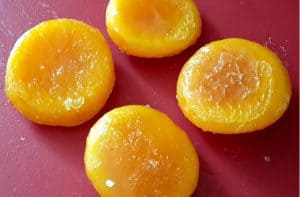
I also cure egg yolks, covered in salt and let to cure for a few days or longer in the fridge, then uncovered and the excess salt rinsed off. The longer the yolks sit in the salt, the harder they become. The hard yolks can be grated into salads or over pasta as a dairy-free alternative to parmesan cheese. Delish!
The picture below shows cured egg yolks.