


If you are worried about using coconut oil since recent headlines called it pure poison, read on for my view to help you decide whether it’s safe for you to consume it.
Since Wednesday, I’ve been getting messages from friends and people who know me who want to know what I think about the recent news, reporting a German professor dismissing any health benefits of coconut oil and calling it ‘pure poison’.

Absence of Evidence Is Not Evidence Of Absence!
First I thought that a new study must have been published actually showing some new evidence to this effect, and as an evidence-based practitioner, I was rather excited to read about what that new evidence might be.
To my disappointment, there is no new evidence! Prof Karen Michels is just wanting to make headlines and is basing her claim on the fact that coconut oil is very high in saturated fat (which actually is a fact!), therefore it must be bad for us (not really a fact, as much of the past research claiming this, has been shown to be flawed!).
As we know, conducting dietary clinical trials is very difficult and expensive, and funding is not easy to find. Therefore, if evidence of the health benefits of coconut oil is lacking or scarce, it’s not because there are no health benefits, it’s because there are not enough existing human trials or those that exist have used too small a sample size for them to have enough statistical power. Absence of evidence is not evidence of absence!
Heat-Stability Of Oils
As I’ve written in my earlier blog post ‘Facts on Dietary Fats’, coconut oil (as well as other saturated fats, e.g. ghee or lard) are great fats to use as cooking fats. Their smoking point is high so they are more suitable for high-temperature cooking methods. High temperatures can damage the chemical structure of fatty acids contained in some oils, creating trans fatty acids, free radicals and other oxidative by-products, e.g. acrylamides, which are harmful to our health.
Coconut oil is more heat-stable and can withstand longer cooking in higher temperatures than polyunsaturated oils (e.g. sunflower oil, grapeseed oil, canola/rapeseed oil), which can get damaged more easily and in a shorter time. It’s important to understand that high-temperature cooking is never the healthiest option but if you use it, then it’s best to stick to using oils that are suited to that kind of cooking method.

Context Matters
Prof Karen Michels is obviously wanting to make headlines by picking one food ingredient and giving it a label of bad (‘bad vs good foods’ usually gets lots of attention!). This is a very reductionist way of looking at diet and nutrition and does not help us at all. All food and diet needs to be considered in the context of the whole diet and lifestyle, so we can’t really say that one food is poison for (all of) us. It all depends on the context!
So what’s your context? Are you eating coconut oil daily by the spoonful and is it the main component of your diet? Are you using coconut oil, while eating lots of processed/fast foods, sugary treats and meals that predominantly contain beige refined carbs? Or are you using it alongside a healthy, varied and colourful diet of vegetables, good quality protein from trusted sources and other good natural fats? Are you genetically predisposed to not handling saturated fats efficiently? What’s lurking in your family medical history?
Nothing is never as simple as the media (and some scientists!) want us to believe! So don’t just believe the headlines, read what’s behind the story and ask questions.
Do I Use Coconut Oil?
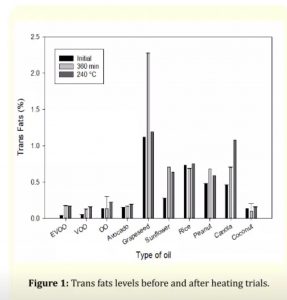
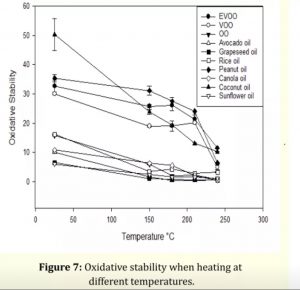
For your information, I’m using coconut oil in my cooking alongside other oils and fats and am not at all worried about its high saturated fat content. It’s only a small part of my diet, which is otherwise very good. However, the one oil I really love and use more and more these days (I go through a large bottle in no time!) is extra virgin olive oil (EVOO). I love the taste and it’s full of polyphenols, which feed the gut microbes and also have great antioxidant potential. And I’ve lately been made aware of a recent study that found that EVOO was one of the most stable oils (after coconut oil!) in terms of oxidation and produced the lowest levels of harmful compounds after heating (followed by coconut oil!). Unfortunately ghee was not included in this study as I’d love to know how it would perform.
The graphs below are from the study1 quoted above (click the thumbnails to be taken to a PDF version of the study).

REFERENCES:
1 De Alzaa F, Guillaume C, Ravetti L. Evaluation of Chemical and Physical Changes in Different Commercial Oils during Heating. Acta Sci Nutr Heal [Internet]. 2018 [cited 2018 Aug 24];2(6).
********
To get personalised advice and recommendations on how you can support your health with nutrition and lifestyle medicine, please book your free 20 minute discovery call to learn how nutritional therapy can help you.
You can also contact me on [email protected].
Join my FREE Facebook Group Healthy New You – For Life for health and nutrition tips and advice and delicious healthy recipes.